

Avoiding home bias: How adding U.S. equity exposure can benefit your portfolio
The addition of U.S. equities to your portfolio can provide many benefits, including sector diversification, access to a larger market, enhanced return potential, and currency hedging.
There is a wide variety of investment opportunities in Canada, but did you know that the Canadian equity market represents only around 3% of the world’s equities? That means that Canadian investors who maintain predominantly domestic portfolios face significant concentration risks due to the relatively limited size, sector composition, and geographic exposure of the Canadian equity market.
Sector diversification
Over two-thirds of Canada’s equity market is concentrated in just three of the world’s 10 main industry sectors: financials (~34%), energy (~17%), and materials (~18%). So, by default, a portfolio of Canadian stocks is heavily weighted in these three sectors.
This concentration exposes Canadian-only portfolios to sector-specific risks and limits exposure to growth sectors. Growth sectors like information technology and health care only represent around 7% and 0.3%, respectively, of the S&P/TSX Composite Index.
In contrast, the U.S. equity market, as represented by the S&P 500 Index, provides higher exposures to information technology (~39%), health care (~8%), and consumer discretionary (~10%). The U.S. market also has around 11% exposure to the financials sector but is more diversified than in Canada.
By adding U.S. equities, Canadian investors gain access to high-growth sectors that are underrepresented or absent in the domestic market, some of which have driven significant market returns over the past decade.
The other benefit of owning stocks from a variety of industry sectors is that it helps to smooth out your risk as economic and other factors can impact each sector differently. If one or two sectors are down, other sectors could see gains that could help offset some of your losses.
Market size and opportunity
In addition to greater sector diversification, the U.S. equity market offers greater scale and depth compared to the Canadian market. The market capitalization of the S&P/TSX Composite Index sits around $5.5 trillion while the U.S. S&P 500 market capitalization is around $99 trillion (USD$70 trillion). The U.S. equity market is almost 18 times larger than the Canadian market.
The size and depth of the U.S. equity market provide Canadian investors access to a far broader investment universe, including global industry leaders and innovative companies not available in the domestic market.
Enhanced return potential
Historically, the U.S. equity market has outperformed Canada, by about 2% annually over the past decade (from March 2016 to February 2026). The annualized return (in Canadian dollars) of the S&P 500 was 15.6% versus the S&P/TSX Composite, which returned 13.7%.
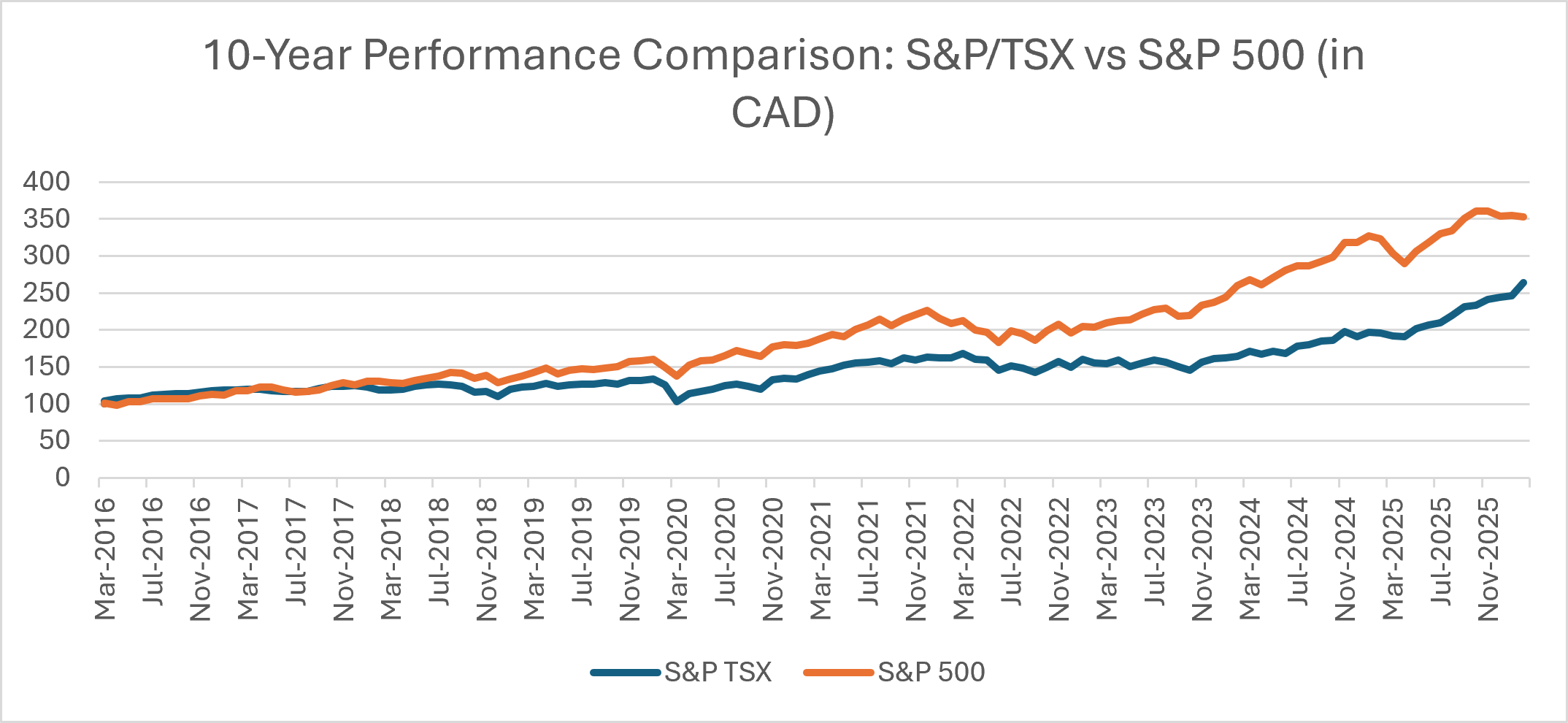
Source: Bloomberg
Two percentage points difference annually compounds over time, demonstrating the opportunity cost of maintaining an exclusively Canadian portfolio.
This doesn’t mean investors should put all their eggs in the U.S. basket, however, despite the U.S. market outperforming Canadian equities in six out of the last nine years. The year-by-year comparison in the chart reveals an important reminder about diversification:
- In 2022, both U.S. and Canadian markets declined, but diversification would have reduced losses
- In 2024, the S&P 500 significantly outperformed (+36.2% versus +21.7%)
- In 2025, the S&P/TSX significantly outperformed (+31.7% versus +12.4%)
Varying performance across years highlights how combining both markets can help smooth returns and reduce portfolio volatility.
The Canadian and U.S. equity markets respond differently to commodity price fluctuations, technology sector performance, currency movements, and each country’s monetary and fiscal policies. But while the two markets tend to move together, there is sufficient independence to provide meaningful risk reduction through diversification.
Reducing concentration in your portfolio
Canadian investors who limit themselves to domestic equities face concentration risk and lose out on significant diversification benefits. Adding U.S. equity exposure provides access to a broader, more diversified market with superior historical returns, complementary sector exposure, and potential risk reduction through imperfect correlation.
If you’re looking to optimize your portfolio, you may want to consider adding U.S. equities to improve your long-term diversification. The addition of U.S. equities has the potential to both enhance and even out your portfolio returns.
Qtrade makes it easy to build a well-diversified portfolio. When you invest with us, you have access to all U.S. and foreign stocks and ETFs listed on the NYSE and Nasdaq with any registered or non-registered account types, no USD account required.
The information contained in this article was obtained from sources believed to be reliable; however, we cannot guarantee that it is accurate or complete. This material is for informational and educational purposes, and it is not intended to provide specific advice including, without limitation, investment, financial, tax or similar matters. This document is published by Aviso Wealth and unless indicated otherwise, all views expressed in this document are those of Aviso Wealth. The views expressed herein are subject to change without notice as markets change over time.